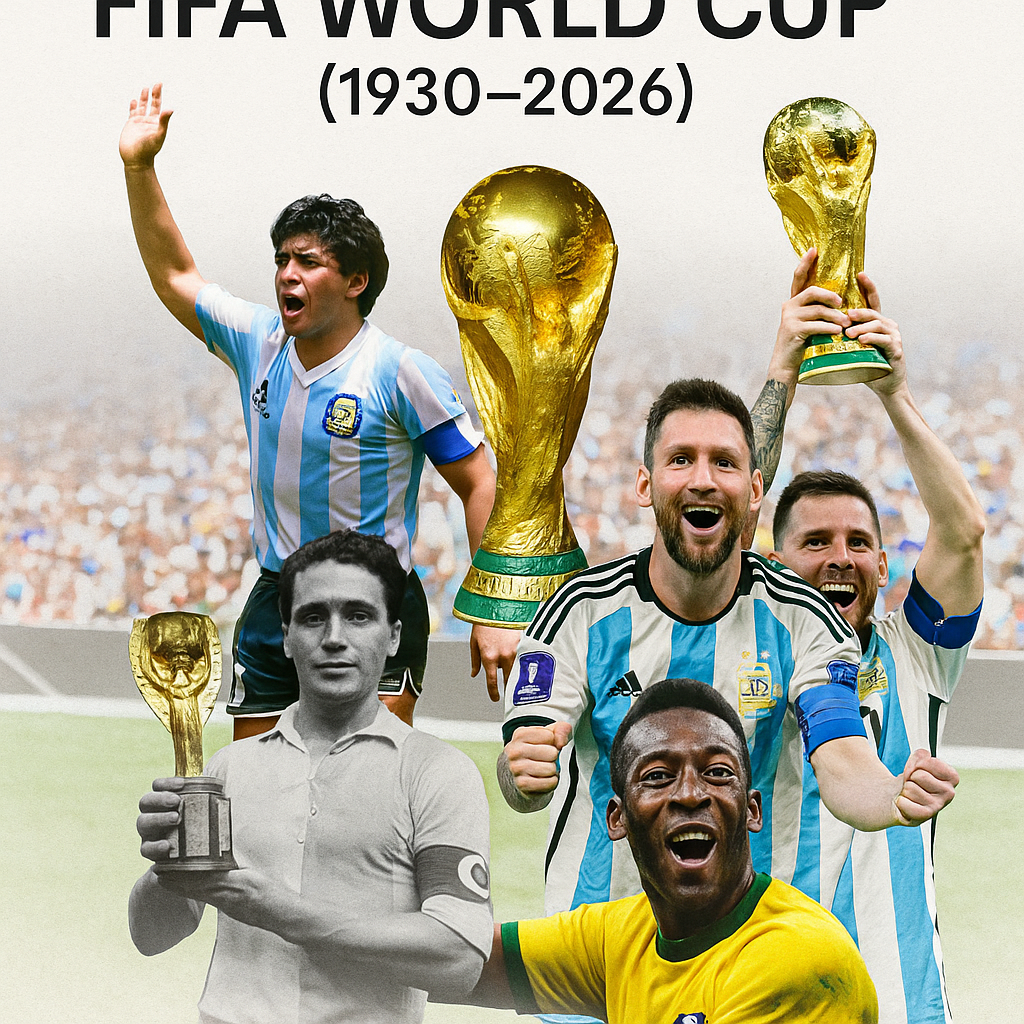
The History of FIFA World Cup is a remarkable journey that spans nearly a century — from a small 13-nation tournament in 1930 to a global event uniting billions of fans. Over the decades, the FIFA World Cup has evolved into the most prestigious and watched sporting spectacle on earth, producing unforgettable moments, legendary players, and cultural milestones that transcend football itself.
Table of Contents
The Beginning of the FIFA World Cup (1930–1950)
The History of FIFA World Cup began in 1930, when the Fédération Internationale de Football Association (FIFA) organized the first official world football championship. Uruguay, celebrating 100 years of independence and being Olympic champions, was chosen as the host nation.
Only 13 teams participated in that inaugural edition, traveling across the world by ship to compete in Montevideo. Uruguay defeated Argentina 4–2 in the final, becoming the first world champions in football history.
The early World Cups were modest in scale but full of passion. The tournaments of 1934 (Italy) and 1938 (France) took place under the looming threat of global war. Then came a long pause — the 1942 and 1946 editions were canceled because of World War II.
When the World Cup finally returned in 1950 in Brazil, it symbolized global recovery and unity. That edition gave birth to one of football’s greatest stories — the Maracanazo, when Uruguay stunned Brazil 2–1 in front of a record-breaking crowd of nearly 200,000 fans. This early period laid the foundation for the History of FIFA World Cup as a tale of triumph, emotion, and global connection.
Golden Age and Expansion (1954–1970)
The 1950s and 1960s marked a turning point in the History of FIFA World Cup, as television broadcasts began bringing matches into millions of homes. The 1954 World Cup in Switzerland, won by West Germany, is remembered for “The Miracle of Bern.”
In 1958, football witnessed the rise of a 17-year-old Brazilian prodigy — Pelé. He inspired Brazil to its first title, and they went on to dominate the next two decades, winning again in 1962 and 1970. The 1970 tournament in Mexico remains iconic, showcasing the beautiful, attacking style of football that Brazil perfected.
This was also the last World Cup to award the Jules Rimet Trophy. After Brazil’s third win, the trophy was given to them permanently, and a new one — the current FIFA World Cup Trophy — was introduced in 1974.
This era defined the global appeal of the sport and showed that the History of FIFA World Cup was not just about competition but also about art, culture, and inspiration.
The Era of Modernization (1974–1998)
As the History of FIFA World Cup progressed, the tournament became more professional, more global, and more influential. In 1974, West Germany hosted and won the first World Cup with the new trophy. That same year introduced a new era of tactical football and television rights that turned the event into a worldwide broadcast phenomenon.
The 1978 tournament in Argentina was politically charged, but it showcased the passion of the host nation as they won their first title. In 1982, the World Cup in Spain expanded from 16 to 24 teams, allowing more nations — especially from Africa and Asia — to participate.
Then came the 1986 World Cup in Mexico, where Diego Maradona delivered one of the greatest individual performances in history. His “Hand of God” goal and his dazzling solo strike against England became defining moments in the History of FIFA World Cup.
By 1990, football had become a truly global language. The World Cup in Italy had record-breaking TV audiences, and the 1994 edition in the United States introduced football to millions of new fans. It was clear by now that the tournament had outgrown its European and South American roots — it had become the heartbeat of world sport.
The 32-Team Revolution (1998–2022)
In 1998, the History of FIFA World Cup entered a new chapter when France hosted and won the first tournament with 32 teams. This change opened the door for greater diversity and more competition from all continents.
The 2002 World Cup, co-hosted by Japan and South Korea, was another milestone — the first edition held in Asia and the first to have two hosts. It saw underdog stories like South Korea reaching the semifinals.
The 2006 World Cup in Germany brought back traditional European strength as Italy lifted their fourth title. Then, in 2010, Africa made history when South Africa hosted the tournament — the first on the African continent. Spain won their first title that year, powered by their signature “tiki-taka” style.
In 2014, the world witnessed both beauty and heartbreak in Brazil. Germany’s 7–1 demolition of Brazil and Mario Götze’s winning goal in the final against Argentina became unforgettable chapters in the History of FIFA World Cup.
Russia 2018 showcased the new generation of football stars. France, led by Kylian Mbappé, lifted their second trophy in an entertaining 4–2 final against Croatia.
Then came Qatar 2022, the first World Cup in the Middle East and the last with 32 teams. It featured one of the greatest finals ever — Argentina defeating France on penalties after a thrilling 3–3 draw. Lionel Messi finally achieved his World Cup dream, securing his place among the greatest in football history.
The Expansion Era (2026 and Beyond)
The next chapter in the History of FIFA World Cup will begin in 2026, when the tournament will expand from 32 to 48 teams. It will be jointly hosted by the United States, Canada, and Mexico — a historic first featuring three host nations.
This expansion aims to make the competition more inclusive and truly global, giving emerging football nations the chance to shine on the biggest stage. The new format will feature 12 groups of four teams each, leading into an expanded knockout phase.
While some critics worry about dilution of quality, others see it as a celebration of football’s worldwide reach. The 2026 World Cup is expected to break all records in attendance, broadcasting, and fan engagement — making it the largest sporting event in human history.
Legacy and Impact of the FIFA World Cup
Throughout the History of FIFA World Cup, the tournament has been more than just a contest — it has been a reflection of humanity’s love for competition, unity, and creativity.
From Pelé’s elegance to Maradona’s magic, from Zidane’s brilliance to Messi’s mastery, every era of the World Cup has produced icons who transcended sport. The competition has also been a mirror of society — affected by politics, technology, and culture — yet always serving as a reminder of what connects us.
Technological innovations like goal-line tech and VAR have modernized the game, while massive global viewership has made the World Cup a multibillion-dollar spectacle. But beneath all the money and fame, the essence remains the same: passion, pride, and the universal language of football.
Conclusion
The History of FIFA World Cup is a chronicle of dreams, drama, and destiny. From the dusty pitches of 1930 Uruguay to the futuristic stadiums of Qatar and the upcoming mega-event in 2026, the journey represents the very best of global sport.
Each tournament has written a new chapter — of hope, heartbreak, and heroism. The FIFA World Cup is not just about winning trophies; it’s about uniting nations, inspiring generations, and reminding the world that football truly belongs to everyone.
As we look ahead to 2026 and beyond, one thing is certain — the History of FIFA World Cup will continue to evolve, captivating hearts and defining the spirit of the beautiful game for generations to come.