Virat Kohli represents far more than runs, records, or trophies; he represents a mindset that refuses to accept limits. In a sport where heroes are built quickly and forgotten just as fast, his journey stands apart because it mirrors real life—success, struggle, doubt, and rebirth. From a fiery Delhi teenager chasing dreams to a global cricketing phenomenon who faced his darkest professional phase in full public view, his story is one of relentless ambition and rare emotional honesty.
This is not just the story of a cricketer. It is the story of pressure, identity, resilience, and the courage to begin again.
Table of Contents
Virat Kohli and the Making of a Champion
Every great rise begins long before the spotlight arrives. Growing up in Delhi, cricket was not a hobby—it was a purpose. Long practice hours, early exposure to competitive cricket, and an unshakable self-belief shaped a young player who was never afraid of responsibility.
The defining moment of his early career came during the 2008 Under-19 World Cup, where leadership and performance went hand in hand. That tournament did not just announce a new talent; it introduced a mindset built for the highest level. Soon after, international cricket followed, and the transition—often brutal for young batters—felt surprisingly natural.
What separated him from many talented contemporaries was not just skill, but intent. He wanted to dominate, not survive. He chased improvement obsessively, sharpened his technique, and learned how to absorb pressure rather than fear it. With every season, confidence grew, and consistency followed.
From Consistent Performer to the Face of Indian Cricket
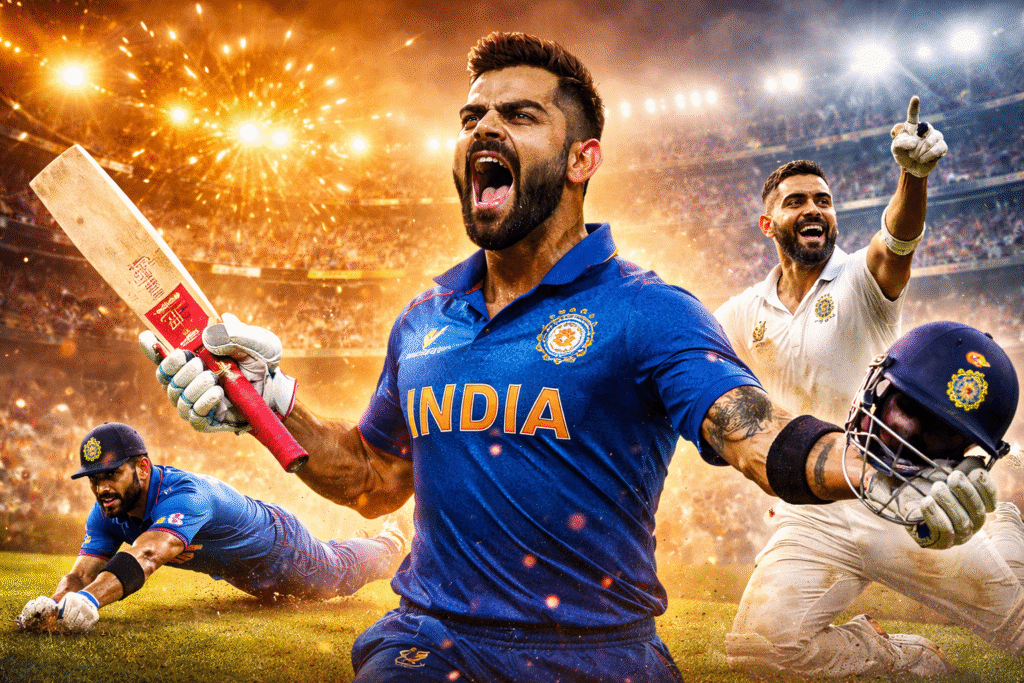
As the years passed, Virat Kohli evolved into the backbone of India’s batting line-up. Across formats and conditions, he delivered performances that defined matches and series. His ability to chase targets with calm precision became legendary, while his Test cricket transformation silenced critics who doubted his adaptability.
Captaincy elevated his role further. Under his leadership, the team embraced aggression, fitness, and self-belief. Winning overseas was no longer treated as an exception but as an expectation. His intensity on the field was unmistakable—sometimes polarizing, always authentic.
Off the field, fame grew rapidly. Sponsorships, global recognition, and massive fan following turned him into a cultural icon. Yet, his connection with fans remained grounded in performance. People believed in him because he delivered when it mattered most.
At his peak, it felt like success was inevitable—every season stronger than the last, every challenge answered decisively.
Virat Kohli and the Weight of Expectations
Then came the phase no one saw coming.
After years of dominance, the centuries stopped arriving. Innings that once ended in celebrations now ended in silence. Matches passed, series passed, and the scoreboard remained stubborn. In a sport obsessed with numbers, the absence of centuries became louder than all past achievements.
For Virat Kohli, the pressure was unique. He was not just another player out of form; he was the standard. Every failure became a headline, every dismissal a debate. Social media amplified criticism, and expectations turned suffocating.
What made this phase especially difficult was the effort behind the scenes. Training intensity never dipped. Fitness levels remained elite. The desire was still burning—but results refused to follow. Leadership roles were relinquished, sparking questions about decline and longevity.
For the first time, the invincible looked vulnerable.
The Silent Battle: Mental Strength Over Public Noise
Unlike injuries, mental struggles leave no visible scars. This period tested more than technique; it tested identity. For someone who had defined himself by excellence, failure felt deeply personal.
Instead of rushing solutions, he chose reflection. Stepping away from constant pressure allowed space to reconnect with the reason he fell in love with batting in the first place. The approach changed—not dramatically, but meaningfully. Less desperation, more patience. Less obsession with outcomes, more focus on process.
It was a reminder that even elite athletes are human, navigating emotions while performing under unforgiving scrutiny.
Virat Kohli and the Art of a Legendary Comeback
Comebacks are rarely dramatic in a single moment. They are built quietly, ball by ball, belief by belief. When the long-awaited century finally arrived, it was more than a statistic—it was release.
From that point onward, rhythm returned. Shot selection looked calmer, footwork sharper, and body language lighter. The hunger remained, but anxiety no longer controlled the innings. Confidence, once shaken, rebuilt itself naturally.
This comeback resonated beyond cricket. Fans saw someone confront failure without excuses and return on his own terms. Younger players found inspiration not in domination, but in resilience. It proved that greatness is not linear—and that pauses do not erase legacy.
Legacy That Goes Beyond Numbers
Records will always tell part of the story, but they will never capture the full impact of Virat Kohli. His influence reshaped how Indian cricketers view fitness, preparation, and professionalism. He made intensity acceptable, ambition celebrated, and self-belief non-negotiable.
His journey also redefined success. It showed that stepping back can be as powerful as pushing forward, and that vulnerability can coexist with strength.
Long after the final innings, his story will remain relevant—not because of how much he won, but because of how he endured.
A Story That Mirrors Real Life
Rise, fall, and comeback—these are not just sporting phases; they are universal experiences. That is why this journey connects so deeply. It reflects ambition tested by reality, confidence shaken by silence, and belief restored through patience.
In modern cricket, few careers capture the emotional complexity of excellence like this one. And as the game moves forward, one truth remains clear: Virat Kohli is not remembered only for being great—but for proving that even the greatest must learn how to rise again.