eVTOL is rapidly emerging as one of the most transformative technologies in modern transportation, offering a new way to move through increasingly crowded cities. What once sounded like science fiction is now becoming a realistic response to urban congestion, pollution, and time inefficiency. As roads reach their physical limits and traditional transport struggles to scale, electric vertical flight is opening an entirely new dimension of mobility above our cities.
Urban transportation has long evolved horizontally—wider roads, taller flyovers, faster trains—but this approach is no longer sustainable. Population density, environmental concerns, and infrastructure constraints demand a fundamentally different solution. This is where electric vertical aircraft enter the picture, promising faster, cleaner, and more flexible city travel by utilizing airspace that has remained largely untapped.
Table of Contents
What Is eVTOL and Why It Matters
At its simplest level, eVTOL stands for electric vertical take-off and landing aircraft. These vehicles are designed to lift off and land vertically, eliminating the need for long runways and enabling operations from compact urban spaces. Unlike conventional airplanes or helicopters, they rely on electric propulsion systems rather than fuel-powered engines.
This distinction is critical for cities. Vertical electric aircraft can operate from small, purpose-built vertiports located close to business districts, residential areas, and transport hubs. This drastically reduces travel time by removing the need to commute to distant airports. Equally important is the environmental advantage. Electric propulsion significantly reduces local emissions and produces far less noise, making frequent urban operations more socially acceptable.
In a world where sustainability is no longer optional, electric vertical flight aligns closely with the long-term goals of smart cities and clean mobility.
How eVTOL Technology Works
The technology behind eVTOL is a convergence of aerospace engineering, electric mobility, and advanced software systems. Instead of one large engine, these aircraft use multiple smaller electric motors distributed across the airframe. This design improves safety, efficiency, and control during vertical and forward flight.
Energy storage plays a central role. Most current designs rely on high-energy-density batteries, while ongoing research focuses on improving range, charging speed, and lifespan. Intelligent power-management systems continuously optimize energy use during different flight phases, from take-off to landing.
Advanced flight-control software ensures stability and precision, especially in complex urban environments. Sensors and onboard computers monitor altitude, speed, weather conditions, and nearby obstacles in real time. Over time, increasing automation is expected to reduce pilot workload and improve operational consistency, making electric vertical flight safer and more scalable.
eVTOL vs Helicopter: Why Urban Mobility Needs a New Approach
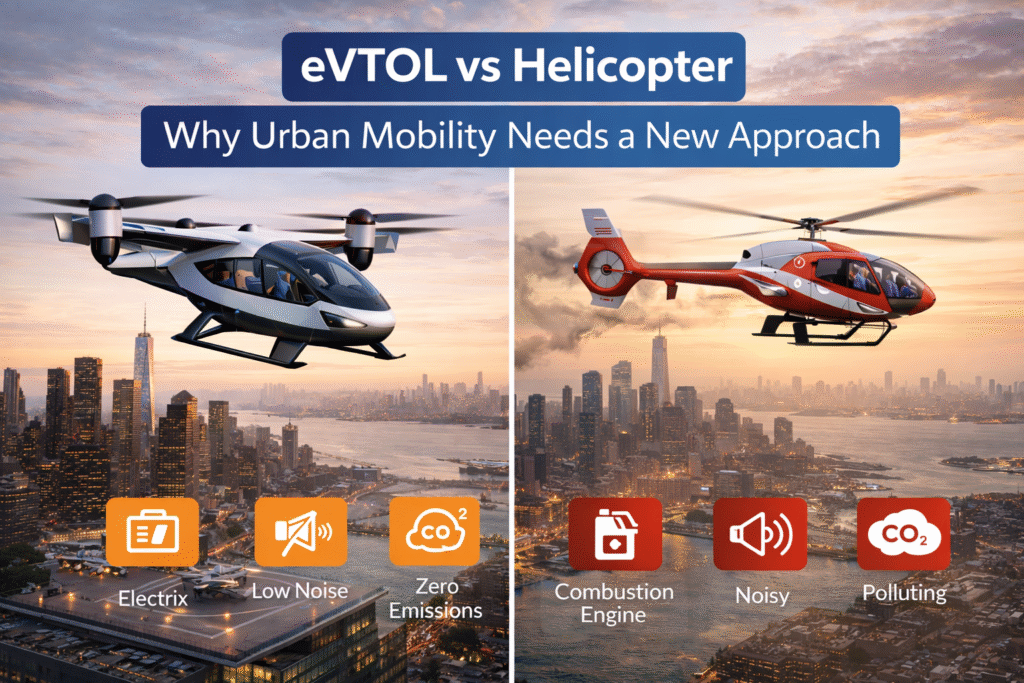
As cities explore vertical flight solutions, comparisons with helicopters are inevitable. While helicopters have proven useful in emergency services and specialized transport, they were never designed for routine urban commuting. eVTOL aircraft approach the challenge from an entirely different perspective.
Helicopters depend on fuel-powered engines that are noisy, expensive to maintain, and environmentally taxing. Electric vertical aircraft use multiple electric motors that prioritize redundancy, efficiency, and reduced noise. Helicopters also face operational limitations that make large-scale urban deployment difficult. Electric vertical flight, by contrast, is being engineered specifically for frequent short-distance trips within cities, where sustainability, cost control, and public acceptance are essential.
This fundamental difference explains why electric vertical aircraft are increasingly viewed as a long-term urban solution rather than a niche aviation alternative.
eVTOL vs Air Taxi: Technology Versus the Service Model
The terms eVTOL and air taxi are often confused, yet they represent different concepts. Air taxi refers to the on-demand aerial transport service, while eVTOL describes the technology that enables such services to function efficiently.
Earlier air taxi ideas relied heavily on helicopters, which limited scalability due to noise, emissions, and high operating costs. Electric vertical aircraft are purpose-built for urban air mobility, offering quieter flights, lower emissions, and designs optimized for frequent take-offs and landings. This is why most modern air taxi visions are built around electric vertical platforms rather than traditional rotorcraft.
Understanding this distinction helps clarify why electric vertical flight is considered the foundation of future city air travel.
The Role of eVTOL in Building “Cities in the Sky”
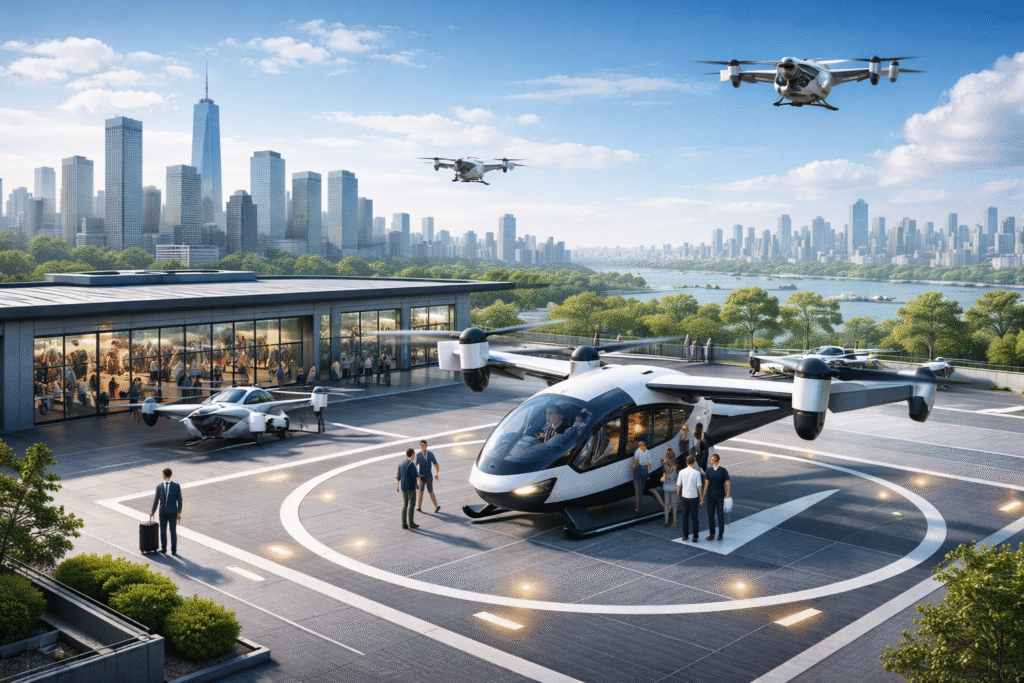
The concept of cities in the sky does not imply floating buildings or airborne neighborhoods. Instead, it represents a future where vertical air routes complement existing ground transport systems. With eVTOL services, journeys that take over an hour by road could be reduced to minutes by air.
This shift has far-reaching implications. Business travel becomes more efficient, emergency services gain faster response times, and urban planning gains new flexibility. Residential areas farther from city centers could remain well connected without expanding road networks. Logistics, healthcare, and time-sensitive deliveries also stand to benefit from direct aerial routes.
As infrastructure such as vertiports and charging stations develops, vertical mobility could become a seamless part of everyday urban life.
Safety, Regulation, and Public Acceptance
Safety remains a central focus in the development of eVTOL aircraft. Aviation authorities worldwide are working to establish certification standards tailored to electric vertical flight. These standards address structural safety, software reliability, battery performance, and operational procedures.
Public acceptance is equally important. For electric vertical flight to succeed, people must trust the technology and feel comfortable sharing urban airspace with it. Early operations are expected to be limited and carefully controlled, gradually expanding as experience, data, and confidence grow.
Challenges That Still Remain
Despite its promise, eVTOL faces several challenges. Battery limitations currently restrict range and payload capacity. Weather conditions and urban airspace management require sophisticated planning and coordination. Infrastructure development demands significant investment and collaboration between governments and private players.
Cost is another consideration. Early services may be premium-priced, but long-term success depends on achieving economies of scale and making electric vertical flight accessible to a broader population.
The Future of Urban Mobility
Even with these challenges, momentum behind eVTOL continues to build. Test flights, pilot programs, and regulatory progress indicate that this technology is moving steadily toward real-world deployment. Rather than replacing existing transport modes, electric vertical flight is likely to complement them, offering a faster option when time and efficiency matter most.
Cities in the sky may not look like science fiction visions, but they do represent a practical evolution of mobility. As electric vertical aircraft mature, they could redefine how people experience distance, time, and connectivity—unlocking the sky as the next frontier of urban transportation.