Samsung Galaxy XR is the kind of device that immediately feels like you’re stepping into the next generation of computing. The moment you pick it up, the premium finish, futuristic design, and lightweight build signal that this headset wants to replace more than just a screen — it wants to become your daily digital workspace.
Table of Contents
Design & Build — First Touch, First Reaction
One of the best parts of the Samsung Galaxy XR experience begins before powering it on. The headset weighs around 545 grams and has an external battery pack that weighs close to 300 grams. Since the battery is not placed inside the headset, your neck doesn’t feel strained and heat doesn’t build up around your face.
The headband uses a dial adjustment system that lets you tighten the fit perfectly without pressure spots. The forehead and back cushions use soft, breathable material, making long sessions more comfortable. There’s also a removable light shield if you prefer a fully immersive mode blocking outside light.
The frame supports a wide IPD range — roughly 54 to 70 mm — meaning users with different eye distances get the right alignment. This reduces eye strain and improves clarity.
Overall, the design feels intentional: balanced weight, clean aesthetics, and comfort that encourages everyday use — not just occasional demos.
Display & Visual Immersion — A Cinema on Your Face
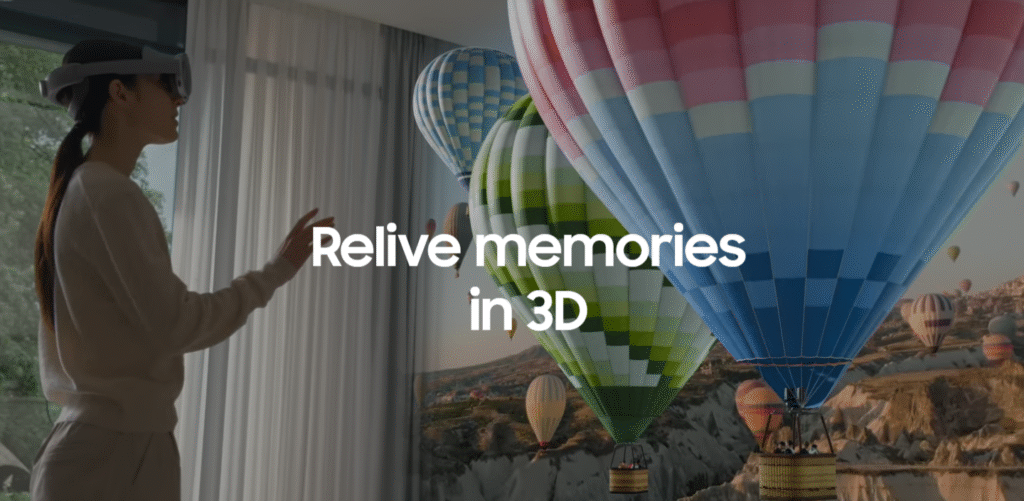
Turn on the Samsung Galaxy XR and the display instantly grabs attention. It uses micro-OLED panels with a resolution of 3,552 × 3,840 pixels per eye — more than 27 million pixels working together to create lifelike visuals.
Key visual advantages:
- Extremely sharp text and edges
- Deep contrast levels
- High brightness for indoor use
- Rich and accurate colors (wide color gamut)
- Field of view around 109° horizontal and 100° vertical
- Refresh rate options that go up to 90 Hz
Whether you’re browsing apps, examining 3D designs, or watching spatial movies, the screen quality refuses to remind you that you’re looking into a headset — it feels more like a window into a new reality.
Passthrough cameras add another layer of magic. They allow you to see your real surroundings blended with digital objects. This means you can walk, pick up items, and interact naturally without removing the device.
Performance & Interaction — A New Way to Control Computing
Inside the Samsung Galaxy XR sits a next-gen Snapdragon XR2+ chip paired with 16 GB RAM and 256 GB storage. The result is fast, fluid performance where apps open quickly and multitasking feels effortless.
But raw power isn’t the only star — the input system is a huge leap forward:
✅ Eye Tracking
Just look at an option and the system knows you want to focus there.
✅ Hand Tracking
Pinch to select, swipe in the air, drag windows around your room.
✅ Voice Commands
Speak and apps respond instantly.
✅ Environmental Mapping
Sensors track your movement and the room layout so virtual elements stay stable.
Together, these interactions make you feel like the digital world is responding to your mind more than your hands. There are moments where the technology almost disappears — and that’s when the future feels real.
Connectivity also keeps it prepared for years ahead: Wi-Fi 7 and the latest Bluetooth mean fast app downloads and smooth wireless streaming.
Battery & Software — Good Today, Better Tomorrow
Battery life currently sits around 2 to 2.5 hours based on usage. For quick work sessions, interactive learning, or entertainment breaks, this is enough. But for long meetings or extended gaming, an extra battery pack or power cable becomes necessary.
The device runs on Android XR, a version of Android redesigned for spatial experiences. This gives two big advantages:
1️⃣ Familiar apps can adapt and run in a 3D workspace
2️⃣ Developers already know the platform — so new app growth should happen faster
The interface allows you to place multiple resizable windows around your room, turning your surroundings into a true multi-monitor setup without physical monitors.
Right now, app quantity isn’t huge — but the foundation is strong, and updates will only make the experience richer.
What’s Already Great in Samsung’s First XR Flagship
⭐ Exceptionally clear displays for both work and entertainment
⭐ Comfortable for long wearing sessions
⭐ Hand + eye + voice = controller-free computing
⭐ Strong internal hardware for multitasking
⭐ Future-ready connectivity and platform approach
This doesn’t feel like a tech toy. It feels like Samsung is building a spatial computer — a new category beyond VR headsets.
Where It Still Needs Growth
No cutting-edge device launches without some caveats:
⚠️ Battery life could be better
⚠️ Ecosystem still growing — especially advanced XR apps
⚠️ Price remains premium
⚠️ New tracking systems can occasionally misread gestures
Most of these weaknesses aren’t deal-breakers — they’re typical for first-generation spatial computing.
Who Should Buy the Samsung Galaxy XR?
✅ Best for:
- Tech enthusiasts & XR creators
- Designers, architects, 3D professionals
- Early adopters excited for the next leap in computing
- Users wanting to replace screens with digital workspaces
❌ Not ideal for:
- Casual buyers who just want fun entertainment
- Anyone expecting full-day battery life
- Budget-focused users
- People who prefer polished, mature app stores
Verdict — Is Samsung Galaxy XR Shockingly Good?
Yes — Samsung Galaxy XR is shockingly good, especially considering it’s a first-generation flagship. The way it blends real and digital worlds feels like the start of a major revolution. You look around your room filled with floating apps and realise:
➡️ PCs became laptops
➡️ Laptops became smartphones
➡️ Smartphones are becoming spatial wearables
It shows us a future where:
- Work happens on virtual screens
- Entertainment fills your entire vision
- Communication becomes face-to-face regardless of distance
- Creativity breaks free from physical limitations
If you’re eager to embrace that future now — this headset delivers enough to justify the jump.
If you prefer waiting for prices to drop and apps to multiply — patience will reward you.
But one thing is already clear:
📌 Samsung Galaxy XR proves spatial computing is the next big shift.