The year 2025 has brought strong EV choices in India’s compact-SUV segment, and two names keep popping up in buyer conversations: Hyundai’s Creta Electric and Tata’s Nexon EV. In this detailed, data-driven comparison I’ll walk you through specs, real-world range, charging, interior and tech, safety, ownership costs, and ultimately who should pick which car — using the latest manufacturer and reputable-auto-site data so you can decide with confidence.
Table of Contents
Quick summary: CRETA Electric 2025 vs Tata Nexon EV
- Battery & range: Creta Electric is offered with two battery options (~42 kWh and 51.4 kWh) and company/ARAI-level ranges that put the long-range Creta in the ~470 km class; Nexon EV is available with ~30 kWh and 45 kWh packs with claimed ranges up to ~489 km (45 kWh).
- Power & performance: Creta Electric targets stronger power outputs (depending on pack: ~133–169 bhp reported) which gives a brisk 0–100 km/h figure; Nexon EV’s higher-range motor is also punchy (~110 kW / ~142 bhp on some spec sheets) with competitive acceleration.
- Charging: Both support DC fast charging; Creta’s 50 kW DC can do ~10–80% in under an hour (around 58 min quoted for specific packs) while Nexon EV supports fast charging (40–60 kW depending on variant) with similar mid-hour fast-charge times.
- Price band (India): Nexon EV has historically undercut premium rivals and is aggressively priced from the low- to mid-₹10-lakhs (ex-showroom) for base EV variants up to higher for top trims; Creta Electric sits higher, reflecting its larger size/kit and Hyundai positioning (Hyundai lists starting prices on its India site).
1. What the makers say: core specs at a glance
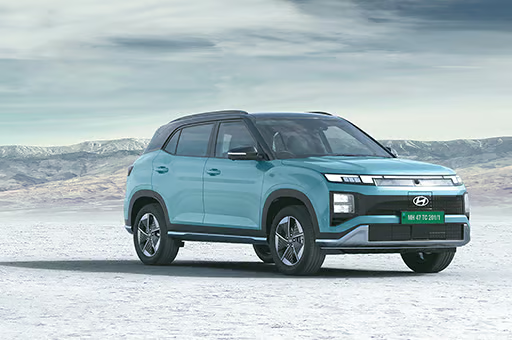
Hyundai Creta Electric (2025) — Hyundai’s India pages and launch coverage list two battery options (42 kWh and 51.4 kWh), AC fast-charge capability (11 kW wallbox), DC fast charging (50 kW reference for quoted charge times), and power outputs reported between ~133 bhp and 169 bhp depending on the pack/variant. Hyundai quotes fast-charge times ~58 minutes (10–80% on certain packs) and AC home charge times of about 4–5 hours with the smart wall-box. Boot space and creature comforts are competitive in the compact-SUV class.
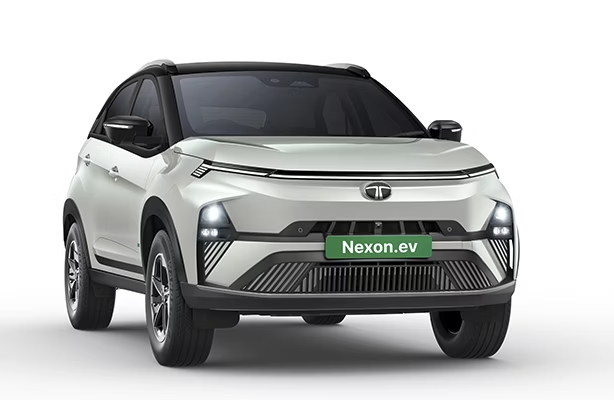
Tata Nexon EV (2024–25 lineup) — Tata continues to offer the Nexon EV with two battery options (commonly listed as ~30 kWh and ~45 kWh across model years), ARAI-claimed ranges that can go up to ~489 km for the larger pack, motor outputs in the ~110 kW / 142 bhp ballpark for the long-range variant, and CCS fast charging capable of bringing the car from low charge to useful levels within 40–60 minutes depending on charger power. Tata has also been adding ADAS and value features to upper trims.
(Note: manufacturers typically quote ARAI or MIDC cycle numbers; real world range will be lower depending on driving style, climate, payload and use of HVAC.)
2. Range & real-world usability
- Claimed (manufacturer/ARAI/MIDC) numbers: Creta Electric’s long-range 51.4 kWh variant is commonly reported around ~470–473 km (ARAI/MIDC-level), while the 42 kWh variant is reported around ~390 km ARAI/MIDC in many listings. Nexon EV’s 45 kWh variant has claimed figures approaching ~489 km on certain cycles, while smaller packs are closer to 275–325 km depending on spec.
- Real-world expectations: Expect roughly 70–85% of the claimed figure in mixed Indian driving. That means practical, everyday real-world ranges typically: Creta 51.4 kWh → ~330–400 km; Creta 42 kWh → ~270–330 km; Nexon 45 kWh → ~340–420 km (varies widely). These are ballpark, but useful for planning.
3. Charging — how fast and how convenient
- Home charging: Both cars support AC wall-box charging. Hyundai offers an 11 kW smart wallbox option for faster home charging (Hyundai lists ~4–5 hours for full charge on certain packs). Tata lists home charging times in the 4–7 hour range depending on charger and battery.
- Fast/ public DC charging: Creta Electric (50 kW DC reference) — ~10–80% in about an hour for eligible packs; Nexon EV (depending on variant and charger) can fast charge to usable levels in roughly 40–60 minutes. In practice the charging network’s power and battery state of health determine real time.
4. Performance & driving character
- Creta Electric: Positioned as a slightly more premium, powerful offering — reports list power in the 133–169 bhp range across variants, and Hyundai advertises brisk acceleration (0–100 km/h figures reported in the mid-7s to 8s seconds for some variants). Expect a composed ride, refined NVH and Hyundai’s typical attention to cabin insulation.
- Nexon EV: Known for punchy in-city performance and a likeable chassis, the Nexon EV’s 45 kWh motor offers competitive acceleration with a real-world feel of instant torque. Tata’s software and motor tuning emphasize usable midrange performance for city and highway overtakes.
5. Interior, features and safety
- Creta Electric: Hyundai tends to pack the Creta with a modern infotainment stack, connected-car features, comfortable seating and premium trim—plus higher boot space figures in Creta’s ICE sibling segment and competitive kit in the EV. Expect driver aids, multiple airbags and a feature set aligned with a higher price bracket.
- Nexon EV: Tata has been strong on features-for-value — large touchscreen, often a JBL sound system on premium trims, ventilated seats on higher variants, and a recent push to add ADAS to Nexon EV 45 variants. Safety credentials are robust with multiple airbags and Tata’s focus on structural strength. Recent Nexon EV updates include Level-2 ADAS options on select trims.
6. Ownership costs, warranty & battery coverage
- Warranty & battery promises: Tata has made headlines by extending very consumer-friendly battery warranties (some programs offering long or lifetime battery coverage on specific high-range models), which is a strong ownership advantage if you’re concerned about degradation and long-term resale. Hyundai offers standard manufacturer warranties; check current promotions for extended battery support at time of purchase.
- Running costs: Both will be significantly cheaper to run per km than ICE equivalents. Insurance, service packs and charging habits will shape total cost of ownership; Nexon EV generally benefits from lower price entry points which can translate to lower EMI/loan costs for similar use cases.
7. Practical comparisons — who wins on what?
- If you want maximum range per rupee: Nexon EV (45 kWh) gives excellent claimed range at a very competitive price — great value proposition.
- If you want a more premium cabin and higher power variants: Creta Electric aims at buyers looking to step up in cabin refinement, equipment levels and slightly stronger performance figures.
- If you prioritize after-sales network & low running cost: Both OEMs have large networks in India; Tata historically has a very broad service footprint and has been aggressive about EV ownership offers (battery warranty moves). Hyundai’s service network and dealer support are also excellent and the company is ramping EV presence strongly.
8. Real-world caveats & buying tips
- Test-drive both — EVs are as much about software, regenerative braking feel and UI as about raw specs. What feels intuitive to you matters.
- Check local charging availability — if you rely on public DC fast chargers, confirm charger types and power at locations you use. Both cars use CCS ports (confirm variant details at purchase).
- Consider battery size for your use — city commuters may be fine with mid-range packs; frequent highway users should opt for larger packs on both models.
- Watch for promotions — extended warranties, home charger bundles, and government/state incentives can change effective price materially.
Verdict — which one should you buy?
- Buy the Nexon EV if: you want the best value-for-money range, lower entry price, and proven real-world ownership experience. It’s an especially strong pick if your budget is tighter but you still want a long-range option.
- Buy the Creta Electric if: you want a more premium package, slightly stronger performance options, and Hyundai’s design + feature set — and you’re willing to pay a premium for those upgrades. It’s ideal if cabin comfort, perceived refinement and available tech are priorities.
Final thoughts
Both Creta Electric 2025 vs Tata Nexon EV present compelling, modern EV propositions — one leaning into premium refinement (Creta) and the other doubling down on value, range and strong ownership economics (Nexon). Your choice should hinge on three questions: What is your realistic daily/weekly driving distance? Do you have reliable home charging? and do you prefer premium comfort over raw range-for-rupee? Answer those, test-drive both, and you’ll have a clear winner for your needs.
If you want, I can create a simple comparison table (specs, price bands, charge times, estimated real-world range) or a personalised recommendation based on your daily km, budget and charging access — tell me your daily commute and budget and I’ll run the numbers.